AGL Organizational Analytics applies validated behavioral data across an entire team, giving you the objective picture that either confirms what you already believed or surfaces what you missed. Both outcomes matter.
Manager opinion is a starting point, not a complete picture. The data fills in what observation alone cannot reach.
Managers identify the leaders who stand out in meetings, speak up in decisions, and build visible relationships. That is not the same as identifying who performs best under pressure, who develops the fastest, or who is actually succession-ready. Behavioral data surfaces talent that observation consistently undervalues, overlooks, or misreads.
A team of strong individual performers can still carry significant collective blind spots: shared risk tolerance that creates uniform decision-making under pressure, concentration of one behavioral style that works until it does not, or the consistent absence of a competency no one on the team has flagged because no one on the team has it. These patterns do not appear in performance reviews. They appear in outcomes.
Engagement and fulfillment data reveals what each leader needs to stay, what they are not getting, and how urgent the gap is. Organizations that rely on performance ratings and manager impressions to assess retention risk discover the problem when the resignation letter arrives. The data identifies it months earlier.
Organizational Analytics applies AGL's validated behavioral assessment platform across an entire team, then synthesizes the results into a consolidated team-level report. The output is not a stack of individual profiles. It is an aggregated picture of the team's behavioral makeup, patterns, and gaps, produced by an AGL consultant with the expertise to interpret what the data means for this specific team and its objectives.
Each participant completes the same 25-minute assessment used across AGL's coaching and selection engagements. The assessment measures behavioral preferences across 175 traits and leadership competencies in the participant's language of choice. What changes in an Organizational Analytics engagement is what happens next: rather than analyzing one person, AGL maps the full team across whichever combination of 12 available competency sets is most relevant to the organization's objectives.
The analysis reveals where the team is strong, where it is consistently thin, what behavioral patterns have likely calcified into cultural norms, and where the team's collective profile creates risk. The findings either confirm what leadership already believed or reveal what it missed. In both cases, the result is decisions made on evidence rather than impression.
Organizational Analytics can run as a standalone engagement or as the opening phase of an AGL Team Acceleration cohort coaching program. When it precedes coaching, the baseline data transforms the first group session and gives the coach and cohort a shared factual foundation to work from.
Not a fixed package. AGL selects and combines sets based on the questions the engagement is designed to answer. A succession-focused engagement looks different from one focused on sales team performance or remote manager effectiveness.
Every Organizational Analytics engagement begins with the questions that matter most to your leaders and your business. The report delivers a direct, data-grounded answer to each one.
Assess engagement, fulfillment, and retention risk across the team. Understand who is aligned and who needs a conversation before the situation changes on its own.
Identify your highest-performing leaders using objective behavioral data, confirm or challenge your existing assessments, and surface the competency gaps where targeted development delivers the greatest return.
Identify individuals ready for expanded leadership roles now and in the future. The report ranks readiness by behavioral data across whichever combination of the 12 competency sets fits the role requirements, not by who is most visible.
Surface succession-ready leaders and build a clear 1- to 3-year pipeline grounded in behavioral data. The report distinguishes between leaders who are ready now and those who are 18 to 36 months away, with specific development actions for each.
Spot flight risks before they leave, using engagement and fulfillment data that reveals what each leader needs to stay. High-risk individuals are flagged with a 60-day recommended action, so the organization acts before the resignation, not after.
Pinpoint the collaboration gaps and behavioral mismatches driving friction. The report identifies natural collaboration anchors, outliers, and specific interventions, and closes with a development roadmap that maps every recommendation to the right next step.
Every engagement produces team distribution charts, individual heatmaps, and 9-box talent matrices, alongside targeted written recommendations for each of the six engagement questions.
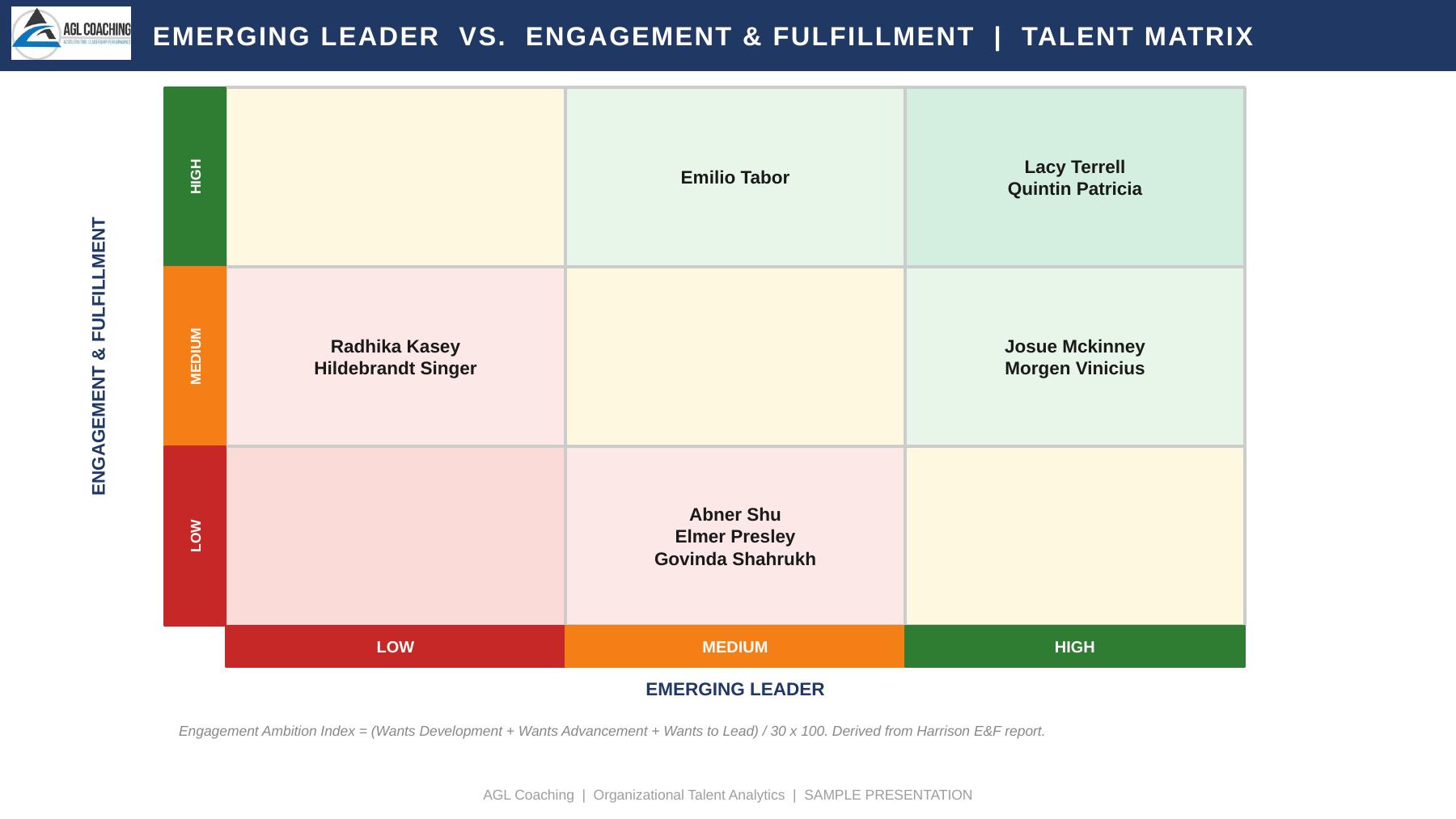
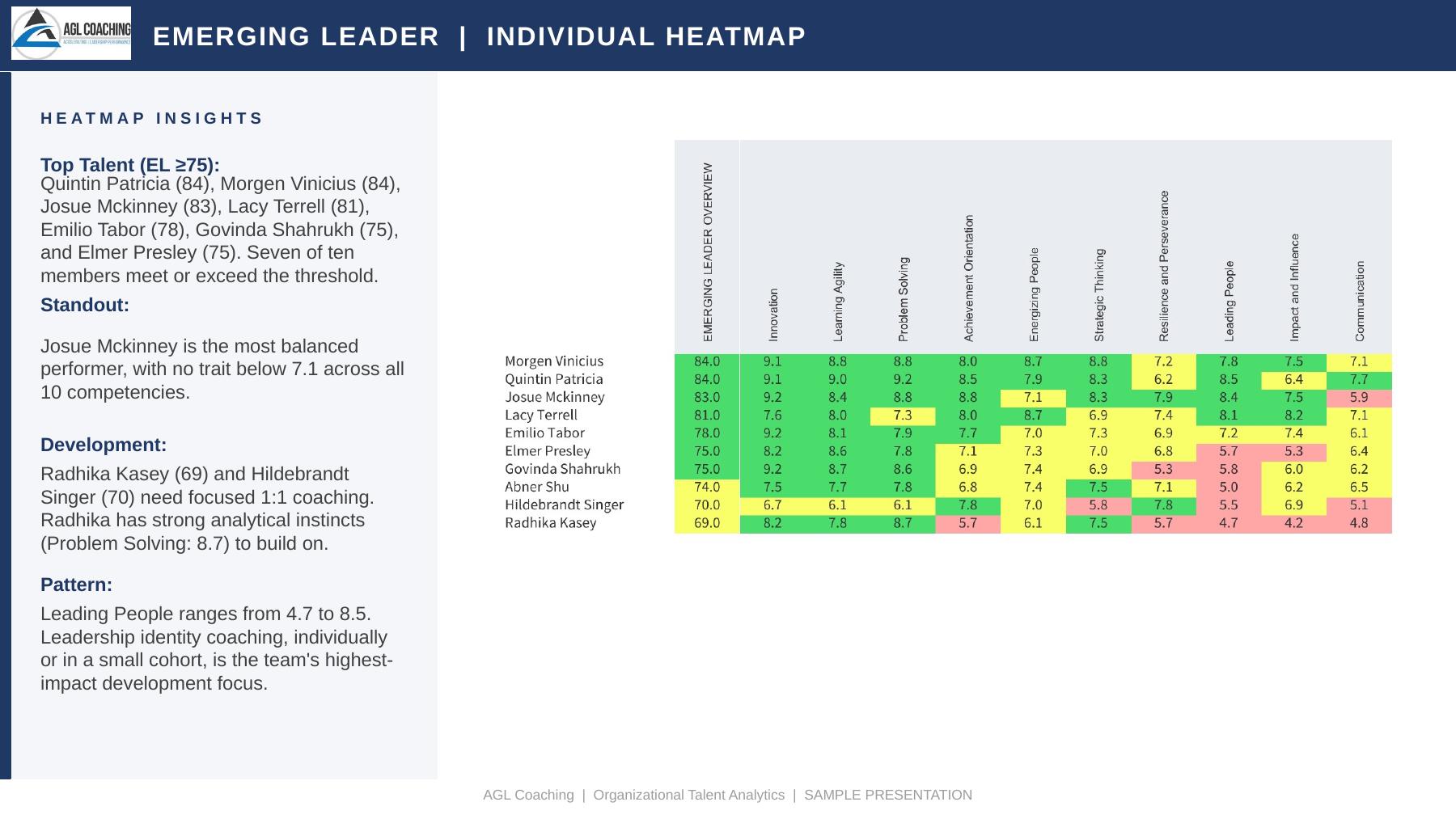
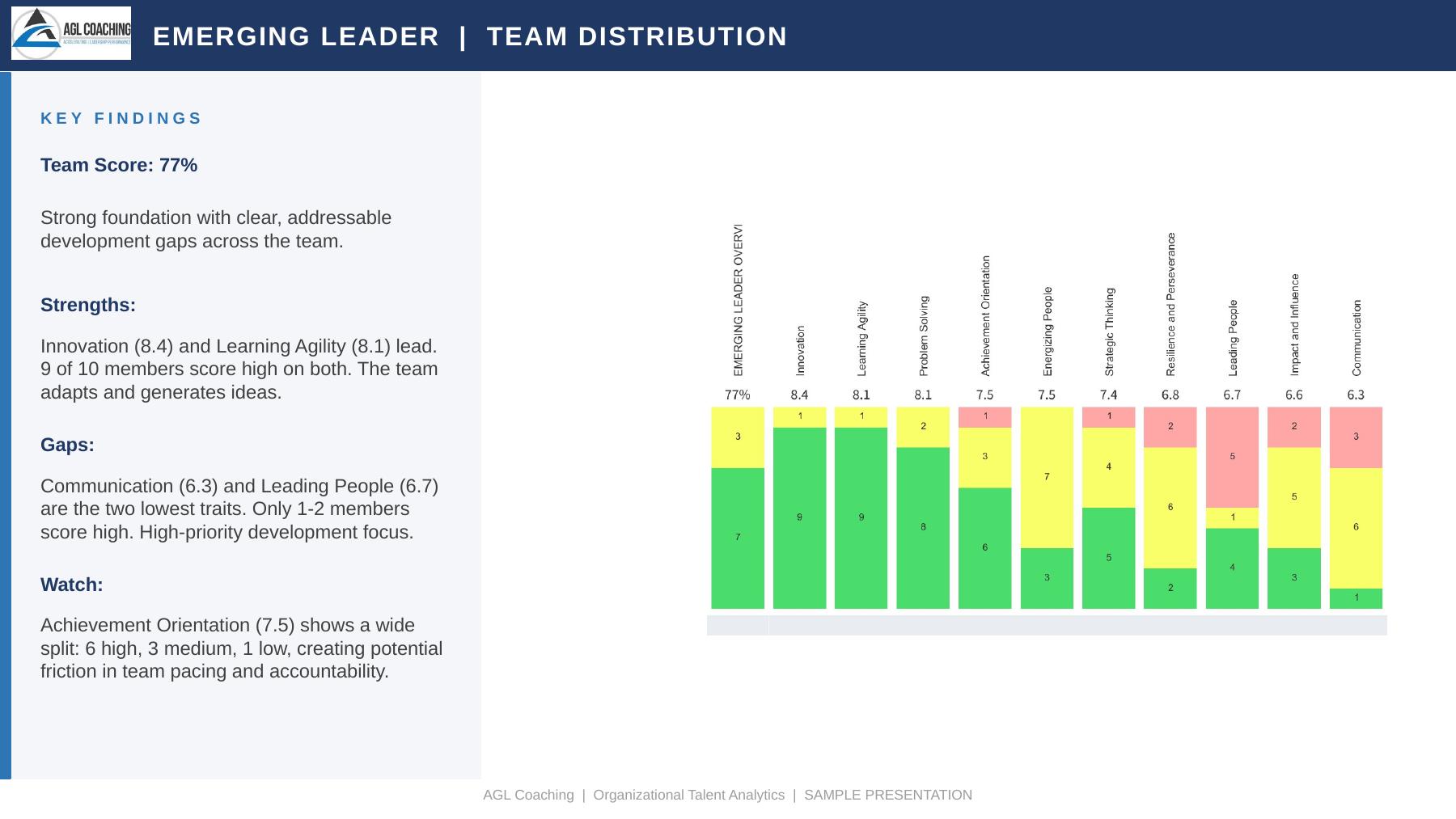
Sample Organizational Analytics Report. Names and data are illustrative.
A structured process that moves from participant assessment to sponsor briefing, with clear findings and a development roadmap at the end.
Each participant completes a 25-minute preferences-based behavioral assessment at their own pace, available in 41 languages. No time pressure, no right-or-wrong answers. Each participant receives their individual profile in a 1:1 debrief with an AGL consultant. Individual findings stay confidential.
AGL synthesizes all individual profiles across your selected combination of competency sets. The analysis maps team distribution, individual heatmaps, 9-box talent views, engagement and fulfillment patterns, and outlier identification, producing the full written Organizational Analytics Report.
AGL presents the findings to the sponsoring leader in a structured debrief session. The conversation covers what the data shows, what it means for this team's specific objectives, and a development roadmap mapping each recommendation to the right intervention: 1:1 coaching, cohort programs, workshops, or internal development.
The output is structured for immediate use by leadership. No decoding required.
A full behavioral profile for each participant, delivered in a confidential 1:1 debrief. Each leader receives a clear picture of their own strengths, motivational drivers, engagement needs, and development areas.
Team-level distribution data across each selected competency set, with key findings: team score, strengths, gaps, and watch areas identified for each dimension.
A heatmap for each participant across every competency set, showing where each leader scores high, medium, or low. Standout performers, development priorities, and cross-member patterns identified by name.
Multiple 9-box views mapping the full team across intersecting competency dimensions. Every team member placed visually so talent patterns, outliers, and succession candidates are immediately apparent.
A dedicated recommendation section for each of the six engagement questions, with named individuals, specific development actions, and timelines. Not generic findings. Specific decisions the data supports.
A structured roadmap that maps every recommendation to the appropriate intervention: 1:1 executive coaching for high potentials and targeted gap leaders, cohort programs for pipeline development, AGL Workshops for team-wide competency gaps, and internal programs for supporting initiatives.
Organizational Analytics pairs naturally with Team Acceleration cohort coaching. The baseline data becomes the foundation for the first group session, transforming what the cohort can accomplish from day one.
Organizational Analytics serves any leader making significant decisions about their team and wanting data behind those decisions.
Understanding the behavioral composition of a team before making decisions about structure, investment, coaching, or succession. The data replaces inference with evidence on questions that have real consequences.
Succession decisions made on behavioral data look different from decisions made on performance ratings and tenure. Organizational Analytics surfaces who is behaviorally ready and what gaps remain in the pipeline.
Two previously separate teams combining bring two different behavioral cultures. Understanding how those profiles overlap, conflict, and complement each other before the integration closes changes how leadership manages the transition.
The recommended opening for any AGL Team Acceleration program. Establishing the behavioral baseline before the first group session transforms the coaching. The coach and cohort begin with shared data rather than spending the first sessions discovering what the report would have revealed on day one.
Share what question you are trying to answer and who the group is. AGL will respond directly.